
Original articleLeadership that leaves institutions stronger
How Do Good Leaders Leave Institutions Stronger Than They Found Them?
A concise introduction to the recurring question behind the wider body of work.
Read the articleConstitutional Stewardship
The work begins with problems institutional leaders recognise: incomplete information, blurred accountability, unrealised potential, weak systems and organisations that become too dependent on individual office-holders.

A concise introduction to the recurring question behind the wider body of work.
Read the articleThe original framework by Paul Adams: a set of principles for exercising temporary authority responsibly.
Read SC-001The framework at a glance
The visual synthesis shows how trust, purpose, potential, judgement, systems, character and legacy fit together as parts of one approach to institutional leadership.
It provides a concise route into the framework without requiring the reader to master its terminology before the underlying ideas become useful.
Open the full-size infographic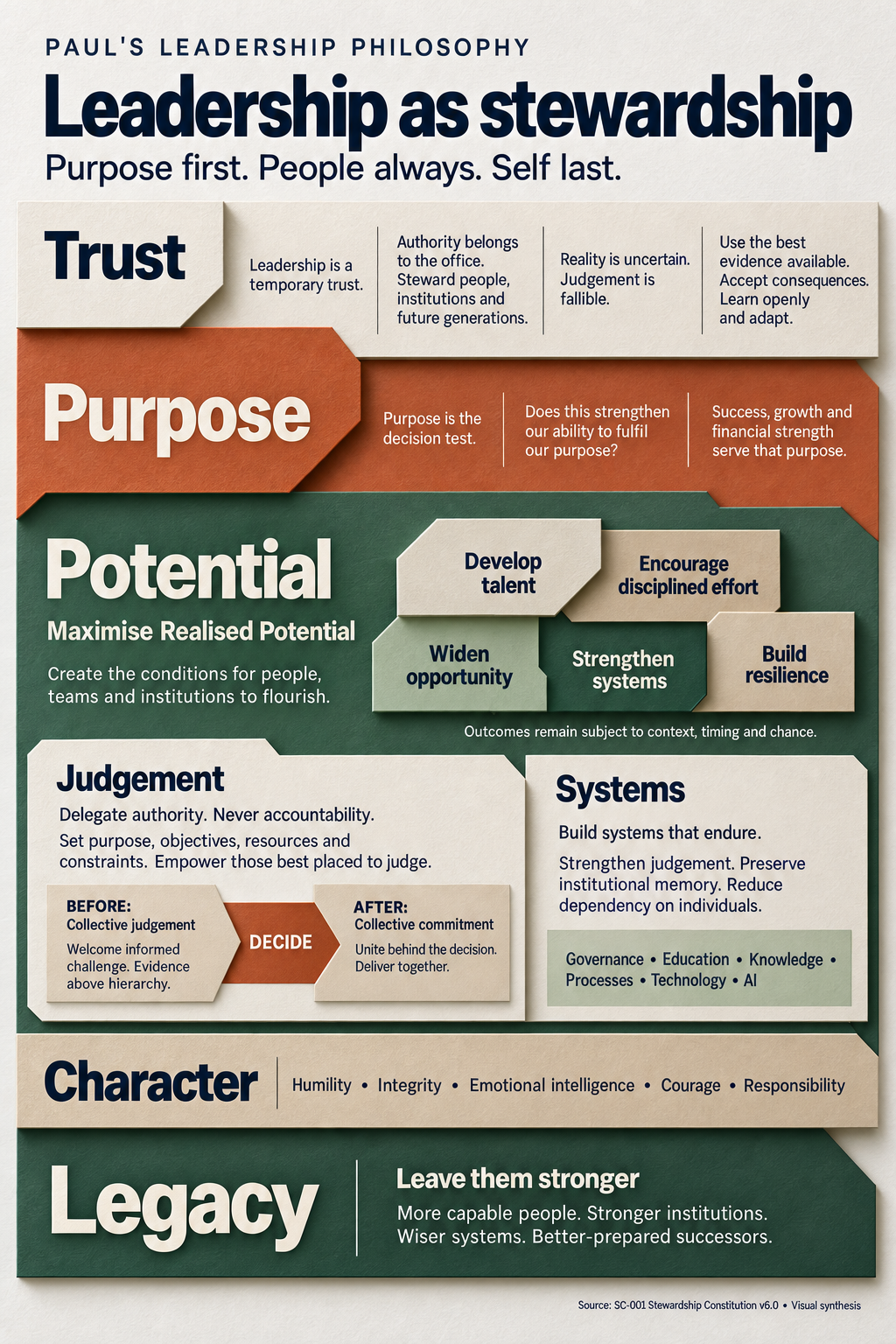
Six connected questions
The themes are deliberately small in number. The evidence changes; the underlying questions remain.
Each starts with a recognisable executive problem and ends with practical application. The philosophy provides coherence; it does not require the reader to learn a branded vocabulary before receiving value.
How can leaders decide responsibly when information is incomplete? The useful distinction is between decision quality and outcome quality: hindsight must not erase what was known, assumed and reasonably foreseeable at the time.
Authority should sit with the people best placed to exercise informed judgement. Accountability remains with the leader who defines the purpose, resources, constraints and decision system.
Talent is only one input. Disciplined effort, opportunity, systems, context, timing and chance all affect what people and institutions can realise. Leaders create conditions; they do not own the result.
Commercial strength, growth and operational excellence matter when they increase the capacity to fulfil legitimate purpose. The enduring test is what remains after the office-holder leaves.
AI can improve evidence, reveal assumptions and preserve memory. It cannot carry constitutional responsibility for purpose, ethics, decisions or consequences.
Humility enables learning; integrity creates trust; courage permits hard choices; responsibility owns consequences. Character matters because it determines what information people are willing to share with the leader.
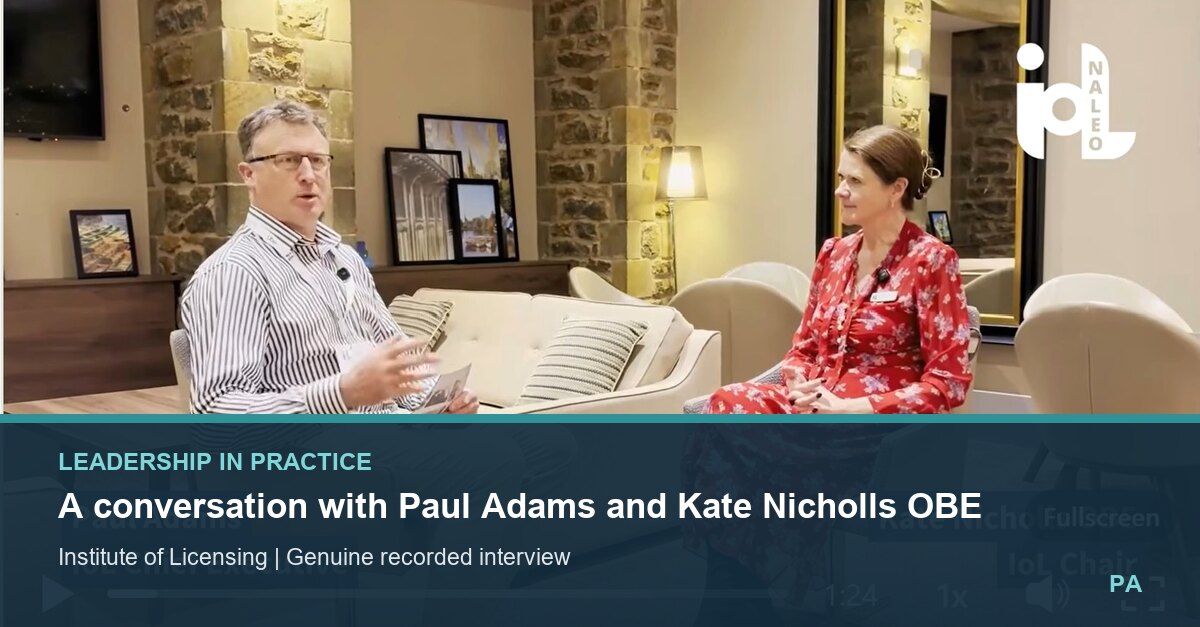
Leadership in Practice: a recorded Institute of Licensing conversation with Kate Nicholls OBE.
From proposition to practice
It makes the basis on which they should be approached clearer—and holds the leader accountable to something more durable than instinct or immediate pressure.
The work is presented as a developing, evidence-led philosophy rather than a universal theory. Established ideas such as Mission Command, stewardship and systems thinking are acknowledged as foundations; the distinctive contribution is their synthesis and application to contemporary institutional leadership.
The governing principle
The philosophy matters only when it improves real decisions: clarifying purpose, strengthening accountability, developing capability and leaving the institution more resilient.
The philosophy is useful only when it is visible in decisions, outcomes and stronger institutions.